-
More Blogs

-
How to Organize Supplier Data Efficiently at Canton Fair 2026: From Fragmentation to AI-Driven Comparison
How to Organize Supplier Data Efficiently at Canton Fair 2026: From Fragmentation to AI-Driven Comparison
 Apr 22, 2026
How to Organize Supplier Data Efficiently at Canton Fair 2026: From Fragmentation to AI-Driven Comparison

At the Canton Fair 2026, the primary constraint for buyers isn't access to suppliers — it's the speed at which raw information can be converted into confident purchasing decisions.
In a single day, you might visit dozens of booths across multiple sprawling halls, absorbing unrelated product categories, varying capabilities, and complex pricing structures. Without a consistent organizational system, this high-value intelligence quickly becomes fragmented and unusable the moment you step off the venue floor.
Today, supplier data organization is no longer just an administrative chore; it is a core technical sourcing capability.
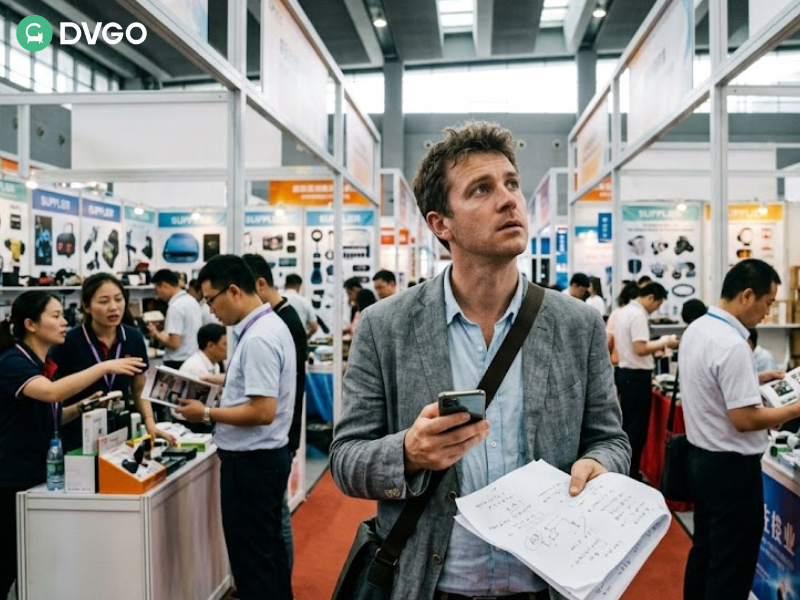
The Breakdown of Manual Tracking in a High-Density Environment
Surprisingly, a majority of Canton Fair buyers still rely on manual tracking: handwritten notebooks, smartphone photo galleries, and scattered voice memos.
While this might feel agile during rapid-fire booth visits, the sheer scale of the Pazhou complex quickly exposes the fatal flaw in this approach. After walking through multiple halls, critical details like pricing logic, Minimum Order Quantities (MOQs), and factory production capabilities inevitably begin to blur.
-
Photos offer a visual reference but cannot be filtered or compared.
-
Notes become inconsistent because each supplier conversation follows a different trajectory.
The result is a frustrating post-fair bottleneck: buyers are left with vague impressions and are entirely unable to reconstruct structured, side-by-side supplier comparisons. Ultimately, million-dollar decisions are forced to rely on flawed memory rather than hard data.
The DVGO Logic: Intelligent Querying vs. Static Storage
At Canton Fair 2026, the core challenge is not whether information is collected, but whether it can be effectively compared. Most buyers suffer from data fragmentation, not data scarcity.
This is where DVGO steps in. Operating as an intelligent supplier comparison engine rather than a clunky traditional database, DVGO revolutionizes sourcing through intent-driven queries.
Instead of requiring heavy manual data entry after a booth visit, DVGO transforms sourcing through intent-driven queries. For example, a buyer searching for specific machinery doesn't need to manually sift through hundreds of brochures. By simply inputting a natural language prompt—such as "Please recommend suppliers of bending machines at the Canton Fair"— DVGO instantly processes the request and structures the output.
Real-Time Comparative Thinking: A Bending Machine Case Study
On the exhibition floor, buyer behavior is sequential. You evaluate suppliers one at a time, making judgments based on immediate context. DVGO elevates this process by shifting your perspective from isolated memory to real-time, relative evaluation.
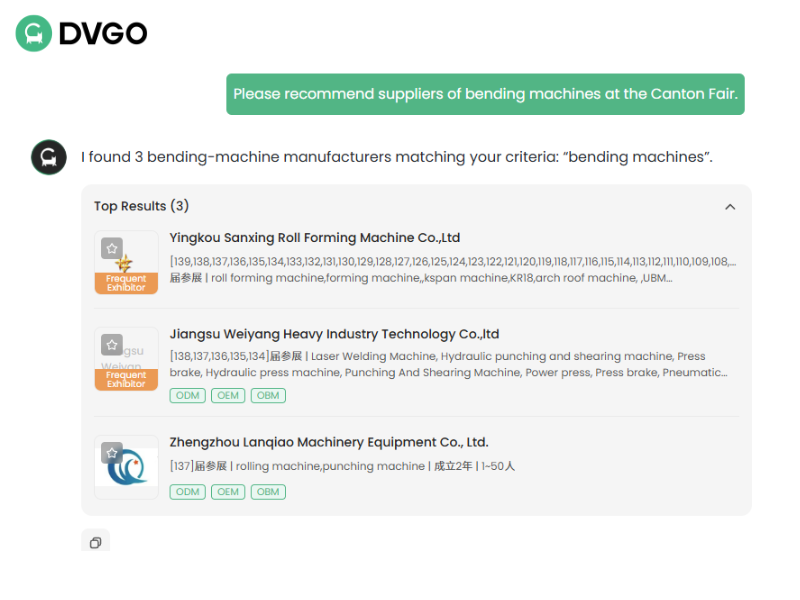
When you query bending machine manufacturers, DVGO doesn't just hand you a static list of names. Out of numerous matches (press brakes, shearing machines, laser cutting machines), the system filters the top results based on critical decision variables. Instead of deciphering scattered notes, you instantly see structured comparison tags:
-
Exhibition History: Highlighting "Frequent Exhibitors" (e.g., 5 sessions exhibited) to gauge trade show reliability.
-
Factory Heritage & Scale: Displaying establishment years (e.g., "12 years") and company size (e.g., "1-50 employees").
-
Customization Capabilities: Clearly labeling production models with tags like ODM, OEM, or OBM.
Consider this: If you are evaluating Jiangsu Weiyang Heavy Industry Technology Co., Ltd., you are no longer looking at an isolated record. You are establishing a benchmark. When you walk over to the next supplier—such as Yingkou Sanxing Roll Forming Machine—you can immediately observe the critical differences in their factory focus, years of operation, and customization flexibility.
From On-Site Interaction to Decision List Formation
Information collected during booth visits has immediate contextual value, but real commercial value is only realized after the exhibition when sourcing decisions are finalized.
Within the DVGO ecosystem, supplier inputs naturally evolve into a dynamic comparison list. This list is not designed to dictate the "best supplier" in a vacuum, but to clearly define the relative position of each factory across key dimensions.
As the number of visited suppliers increases across Phase 1, Phase 2, and Phase 3, human memory fails to maintain stable multi-variable comparisons. The DVGO logic offloads this burden. The core improvement is not just data completeness, but decision speed.
Conclusion: Optimizing the Sourcing Pipeline
The real challenge at the Canton Fair 2026 is information processing. The role of DVGO is not just to replace manual recording, but to redefine how sourcing information is retrieved and utilized.
By utilizing AI-driven search criteria and structured data tags, every supplier interaction becomes part of a comparative decision system. This framework gradually improves sourcing judgment by shifting the process from experience-based assumptions to hard, structured comparative logic—directly impacting the quality and efficiency of your final purchasing decisions.
👉 Explore more information here:https://www.deepvoyage.ai/en/events/canton-fair-2026/home