-
More Blogs

-
Canton Fair 2026 First-Timer Guide: Transport, Badges, and After-Hours Survival
Canton Fair 2026 First-Timer Guide: Transport, Badges, and After-Hours Survival
 Apr 20, 2026
Introduction: Welcome to the Largest Trade Show on Earth
If you are preparing for the 2026 Canton Fair (China Import and Export Fair) in Guangzhou, congratulations. You are about to attend the largest, most comprehensive, and arguably the most overwhelming trade exhibition on the planet. Covering over 1.5 million square meters—roughly the equivalent of 200 football fields—and hosting tens of thousands of exhibitors, the sheer scale of the Pazhou complex is difficult to comprehend until you are actually standing inside it.

For first-time international buyers, however, this massive sourcing opportunity often comes with a significant amount of logistical anxiety. The structural complexities of traveling to China can be daunting. How do you seamlessly get from the airport to the venue without getting lost? Where do you get your official buyer badge without waiting in a chaotic line for three hours? And most importantly, after walking 25,000 steps during the day, where do you go at night to actually sit down and negotiate with your new suppliers in a productive environment?
This comprehensive guide is designed to remove the guesswork and lower your blood pressure. We have broken down the Canton Fair survival process into chronological steps—from the moment you land at Guangzhou Baiyun International Airport to the crucial after-hours business dinners. Let's get you ready for a highly efficient, seamless sourcing trip.
Phase 1: Landing in Guangzhou & Transportation Logistics
Your Canton Fair experience begins the moment you clear customs at Guangzhou Baiyun International Airport (CAN). Navigating from the airport to the downtown core or the Pazhou exhibition area requires a bit of pre-planning, as Google Maps will not provide accurate real-time transit data. Here are the three most reliable ways to navigate the city.
The Metro System: Cheap, Fast, but Physically Demanding
Guangzhou possesses one of the most efficient and expansive subway systems in the world. If you are traveling light, the Metro is highly recommended. You will likely board Line 3 at the Airport South or Airport North stations. To get to the Canton Fair complex, you must ride Line 3 to Kecun Station (客村) and transfer to Line 8, eventually getting off at either Xingangdong Station (for Area A) or Pazhou Station (for Area B and C).
While the Metro costs only a few dollars and bypasses all surface-level traffic, be warned: the transfer at Kecun Station during the morning rush hour (8:00 AM to 9:30 AM) is intensely crowded. Furthermore, if you are carrying heavy luggage, navigating the underground staircases can be exhausting. You can pay for metro tickets using Alipay or WeChat Pay directly at the digital kiosks.
Ride-Hailing Apps (DiDi): The Business Standard
For most international business travelers, ride-hailing is the preferred method of transportation. Before you arrive in China, download the "DiDi" app (the Chinese equivalent of Uber). The app has a full English interface and features an automatic in-app translation tool that allows you to text your driver in English while they read it in Chinese. At Baiyun Airport, follow the specific signs for "Ride-Hailing Pick-Up Zones" (usually located in specific parking garages adjacent to the terminal). A ride from the airport to the Pazhou area will typically take 45 to 60 minutes, depending on traffic, and cost approximately 150-200 RMB.
Traditional Taxis: The Backup Plan
If you have not set up your digital payment apps yet, you can use the official taxi ranks outside the arrivals hall. Ignore anyone who approaches you inside the terminal offering a "private car", as these are often unlicensed and overpriced. Always insist that the driver use the meter. It is highly recommended to have your hotel name and address printed or screenshotted in Chinese characters, as the vast majority of local taxi drivers do not speak English.
Phase 2: The Buyer Badge Survival Strategy
One of the biggest mistakes a first-time visitor can make is assuming they can simply show up at the Pazhou complex on opening morning to get their entry badge. If you do this, you will spend your first morning standing in a line of thousands of people, wasting valuable sourcing time.
Rule 1: Pre-Register Online
Weeks before you arrive, you must complete the pre-registration process on the official Canton Fair website. Once approved, you will receive a Buyer E-invitation and a pre-registration barcode. This barcode is your golden ticket. Print it out or save it securely on your phone.
Rule 2: Use the Designated Hotels
Do not go to the exhibition center to get your physical badge. Instead, take advantage of the "Overseas Buyers' Registration Offices" set up in dozens of designated luxury hotels across Guangzhou (such as the Garden Hotel, The Westin Pazhou, or the Shangri-La). You do not need to be a guest at these hotels to use their registration services.
When you arrive at the hotel desk, you will need your passport, a physical business card, a passport-sized color photo, and your pre-registration barcode. The process at a hotel usually takes less than 15 minutes, allowing you to walk straight into the fairgrounds the next morning through the fast-track lanes. Keep this badge safe — it is valid for multiple sessions and years. Losing it means paying a hefty replacement fee (usually around 200 RMB) and wasting time in the replacement queue.
Phase 3: Surviving Inside the Pazhou Complex
Once you cross the security gates into the 1.5 million square meters of exhibition space, physical endurance and strategic planning become your most important assets. The fair is divided into distinct phases and massive zones (Area A, B, C, and D), making navigation a marathon rather than a sprint.
Footwear and Physical Preparation
You will easily exceed 20,000 to 25,000 steps per day. Do not wear stiff corporate dress shoes or high heels to the venue. Experienced buyers prioritize high-quality, supportive walking shoes or premium sneakers. The dress code for buyers is "business casual", but comfort on the floor dictates your stamina.
Digital Networking vs. Physical Catalogs
In the past, buyers would bring rolling suitcases to collect heavy paper catalogs. Today, the Chinese business ecosystem is entirely digital. Almost every supplier will want to scan your WeChat QR code. Download WeChat, set up your profile with your company details, and use the platform's built-in translation feature to communicate with vendors seamlessly. Ask suppliers to send you digital product catalogs (PDFs) directly through WeChat, saving you from lugging around ten pounds of paper.
Food, Hydration, and Connectivity
Finding a quiet place to eat during the peak lunch hour (12:00 PM to 1:30 PM) is incredibly difficult. The fast-food restaurants (McDonald's, Papa John's) in the basement levels will have lines stretching out the door. Smart buyers pack high-protein snacks and adjust their lunch schedules to eat at 11:15 AM or 2:00 PM.
Regarding connectivity, while the Canton Fair provides free Wi-Fi, it is notoriously slow due to network congestion. Ensure you have purchased an international data roaming plan or installed a travel eSIM with a built-in VPN before landing, allowing you to access Gmail, WhatsApp, and Google services without interruption. Furthermore, bringing a high-capacity power bank, scanning QR codes, taking product photos, and translating conversations will drain your phone battery by mid-afternoon.
Phase 4: After-Hours & The Real Business
It is 6:00 PM. The exhibition halls are closing, and thousands of attendees are flooding the subway stations. Your feet are aching, and you are holding a notebook filled with preliminary quotes and factory details. But the real work of international trade is just beginning. In B2B commerce, what happens after the exhibition often dictates the success of what happened inside it.

Why You Must Leave Pazhou at Night
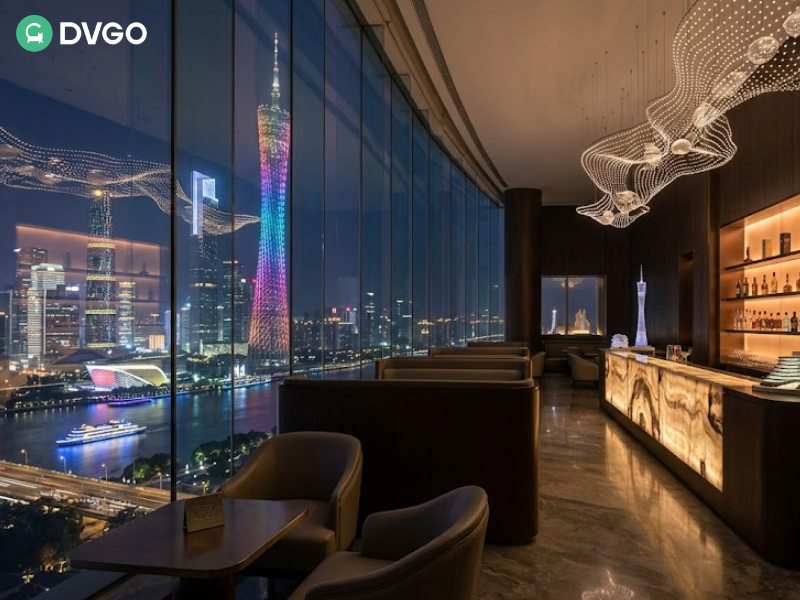
The Canton Fair complex is optimized for daytime trade exhibitions, not evening social life. While the immediate area has high-end hotel lounges, the environment is sterile, overpriced, and completely disconnected from the actual city. To find venues suitable for deep business networking, client entertainment, or unwinding with your team, you need to head 15-20 minutes away to the Tianhe or Yuexiu districts.
Strategic Environment Selection
When you invite a potential supplier out for evening drinks or dinner, you are shifting the dynamic from a rigid buyer-seller negotiation to a partnership-building scenario. You cannot afford to choose a random bar that turns out to be a deafeningly loud nightclub or a tacky tourist trap. You need an environment designed for conversation, trust-building, and authentic local experience.
Enter DVGO and the After-Hours Map
Stop settling for outdated map listings that lack real-world business context. In the fast-paced exhibition season, experienced buyers leverage AI-powered travel intelligence to stay ahead. DVGO acts as your dedicated AI travel assistant in China, featuring the curated After-Hours Map—a specialized tool designed to filter Guangzhou’s nightlife through a professional lens.
Whether you need a discreet whisky bar for a sensitive contract review, an upscale livehouse to showcase local culture to a key client, or a relaxed craft beer taproom to build rapport with a new vendor, we remove the guesswork. Every recommendation is context-aware, ensuring your evenings are spent closing deals and deepening partnerships, not wandering the streets.
Stop searching and start connecting. Explore the After-Hours Map now to secure the perfect venue for your next business breakthrough. 👉 Visit the Map
The Mega FAQ Section: Essential Quick Answers
To ensure you are fully prepared, here are the most frequently asked questions by first-time Canton Fair attendees.
Q1: Do I need a visa to attend the Canton Fair?
Yes, most international buyers require a business visa (M Visa) to enter China. However, China has recently expanded its visa-free entry policies for several countries (such as many European nations and Southeast Asian countries) for stays of up to 15 or 30 days. You must check the latest policies with your local Chinese embassy. If you need a visa, the Canton Fair official website provides an official invitation letter once you complete your online pre-registration, which is essential for your visa application.
Q2: Should I stay near the Pazhou Complex or in the city center?
This is a classic first-timer dilemma. Staying right next to the Pazhou complex saves commuting time in the morning, but the immediate area becomes a ghost town at night with very few options for dining or client entertainment. Staying in Tianhe District or Yuexiu District means a 20-30 minute morning commute, but places you directly in the heart of Guangzhou's best restaurants, business hubs, and curated nightlife (which is crucial for after-hours networking).
Q3: Can I use cash or international credit cards inside the venue?
China is a nearly cashless society. While major international hotels will accept Visa and Mastercard, almost all daily transactions—from buying a coffee inside the fair to paying for a taxi or a business dinner—are done via WeChat Pay or Alipay. Before you land, download both applications, verify your identity, and bind your international credit card. Do not rely heavily on cash, as many small vendors inside the exhibition halls and local taxi drivers may not have change.
Q4: Is the official Wi-Fi reliable enough for work?
The Canton Fair provides free Wi-Fi, but with hundreds of thousands of attendees, the network can become extremely congested and slow, especially during peak afternoon hours. If you need to send large design files, access international websites (like Google or WhatsApp), or video-call your home office, it is highly recommended to purchase an eSIM with a built-in VPN before arriving in China, or arrange a robust high-speed roaming package through your local telecom provider.
Q5: Where should I take a client after the fair closes?
Never take a client to a random bar near the exhibition hall found through a generic web search. High-stakes B2B relationships are built in environments that encourage trust and natural conversation. For the best curated venues that suit business networking rather than loud tourist partying, use the Canton Fair After-Hours Map provided by DVGO. It evaluates Guangzhou's nightlife specifically for business intent, ensuring you never waste an evening in an atmosphere that hinders your negotiation momentum.
Q6: How do I handle the language barrier if I don't speak Chinese?
While many large manufacturers at the Canton Fair have English-speaking sales representatives, smaller specialized factories may only have basic English skills. Download the offline translation packages for Google Translate or Baidu Translate. More importantly, use WeChat's built-in translation feature for all text communication. If you are conducting highly technical negotiations, it is highly advisable to hire a local bilingual sourcing agent or interpreter for the duration of the fair.
Q7: How do I get product samples back to my home country?
By the end of the fair, you will likely have accumulated a significant amount of product samples. Do not attempt to pack all of these into your checked luggage, as you will face exorbitant airline overweight fees. There are numerous international logistics and courier services (such as DHL, FedEx, and local freight forwarders) operating booths directly inside the Canton Fair complex. You can box up your samples and arrange international shipping directly from the exhibition floor to your home office.