-
More Blogs

-
Why Google Maps Fails at Canton Fair: The Hidden Cost of Bad Venue Selection
Why Google Maps Fails at Canton Fair: The Hidden Cost of Bad Venue Selection
 Apr 20, 2026
The Illusion of Reliability: Why Listings Look Right but Fail in Practice
At first glance, searching for "bars near Canton Fair" on Google Maps yields a comforting illusion of choice: dozens of results complete with ratings, photos, and reviews that make the system appear perfectly functional. However, for international business travelers operating under the high-pressure environment of the Canton Fair, this is exactly where the platform quietly breaks down. The failure isn't technical; rather, the underlying data was simply never designed to support high-stakes, time-sensitive business decisions in a complex market like China.
Most travelers naturally assume that a high rating guarantees a suitable experience, but in Guangzhou during exhibition season, this assumption frequently leads to disaster. A typical search result hides several critical blind spots: reviews are often outdated or written by casual tourists rather than business professionals, and the actual venue context—whether it caters to raucous nightlife or quiet networking—is completely missing. Because many highly-rated listings are optimized purely for local consumer traffic, the language and cultural framing severely distort the reality of the venue. What looks like an abundance of choice is actually uncurated noise masquerading as structured data.
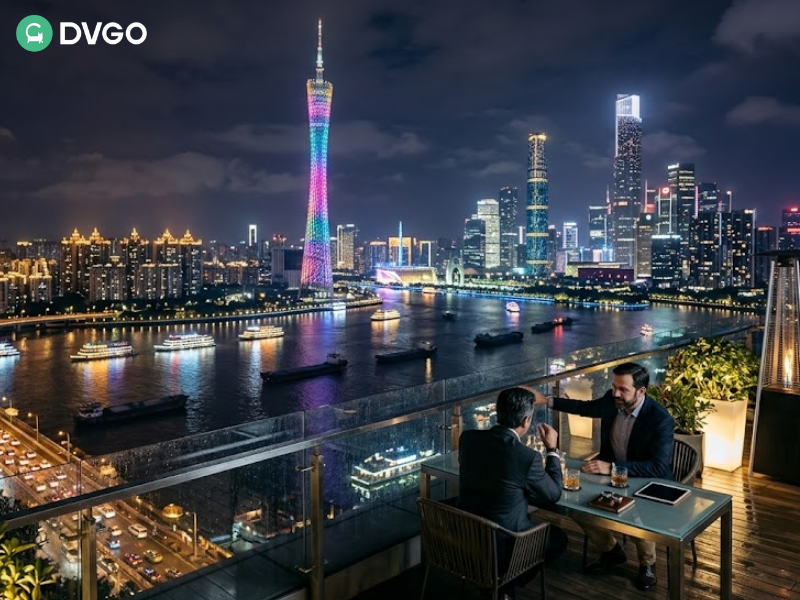
The Core Problem: Missing Context in a High-Stakes Environment
The Disconnect Between Global Apps and Buyer Realities
Global mapping applications operate on a fundamental, yet deeply flawed, assumption: they presume the user already possesses a baseline understanding of the local cultural, geographical, and social environment. Canton Fair visitors, however, are navigating unfamiliar city layouts under severe psychological and temporal constraints. After spending ten hours traversing the massive Pazhou complex and juggling high-value supply chain negotiations, their free time after 8:00 PM is incredibly scarce. When a buyer stands in a hotel lobby searching for a place to drink near the exhibition center, they are not looking for raw geographical data or a simple list of coordinates. They are actively seeking strategic decision guidance to salvage their evening and seamlessly advance their business agenda.
The Walled Garden of China's Digital Ecosystem
Guangzhou introduces structural complexities and digital barriers that most first-time travelers deeply underestimate until they are actively stranded. First, there is profound platform fragmentation. While Google Maps suffers from severely outdated local coverage and often requires unstable VPN access, the hyper-local alternatives that actually hold accurate, real-time data—such as Amap, Baidu Maps, or Dianping—exist within a walled digital garden. These domestic platforms remain highly inaccessible to foreign professionals due to rigid language barriers, frequently requiring local phone numbers or Chinese ecosystem integrations just to view detailed insights. Consequently, the international buyer is left operating in a digital blind spot, forced to make critical networking decisions based on a fraction of the actual available information.
The Fatal Flaw of Unlabeled Context
Furthermore, the city's highest-quality venues are optimized strictly for domestic consumer traffic, leaving English contexts either entirely missing or painfully machine-translated in a way that strips away all atmospheric nuance. But the most dangerous pitfall is the absolute lack of "use-case labeling." A standard map might show a brilliant 4.8-star rating, but it will never tell you why it earned those stars. It won't warn you that a highly-rated lounge is actually a booming, internet-famous photo destination flooded with loud weekend crowds, making it physically impossible to discuss a manufacturing contract. Standard maps cannot differentiate whether a venue features quiet corner booths for formal business meetings, offers the right cultural vibe for client entertainment, or is strictly meant for casual partying. In a high-stakes B2B context, this missing layer of environmental intelligence isn't just a minor inconvenience—it is a direct liability to your negotiation strategy.
Beyond Convenience: The Hidden Cost of the Wrong Venue
Choosing the wrong venue after a grueling day at the Canton Fair is not merely a lifestyle inconvenience; it is a direct threat to your business outcomes. A venue with deafening music instantly kills negotiation depth, while a tourist-heavy bar severely reduces your perceived professionalism, often forcing you to shorten the meeting altogether.
Imagine transitioning a serious supplier discussion into a crowded, chaotic room simply because it looked "highly rated" online. The result is not just physical discomfort—it is the irreversible loss of negotiation momentum and shattered trust. During standard travel, a bad bar is just a bad drink; during the Canton Fair, every evening is a critical networking window where every location choice directly impacts communication quality and deal progression.

From Searching to Deciding: The Rise of Travel Intelligence
Experienced buyers no longer rely on open search systems. Instead of randomly finding places, they deliberately select environments based on their specific interaction intent. They prioritize atmosphere over proximity, filter by business scenario, and value curated context over generic star ratings. This behavioral shift—moving from searching for data to relying on decision intelligence—has given rise to a new category of travel tools.
Instead of scrolling through static, outdated listings, modern business travelers leverage AI-based travel intelligence systems like DeepVoyage Go(DVGO). An AI assistant doesn't just show you a pin on a map; it interprets whether a location naturally supports your conversation flow, evaluates the commute from Pazhou against your tight schedule, and matches the venue perfectly to your specific evening objective.
A Simple Comparison: Maps vs. AI-Curated Systems
| Feature | Google Maps (Guangzhou) | AI-Curated Travel System (DVGO) |
| Data Accuracy | Inconsistent / Outdated | Context-aware / Dynamically Updated |
| Business Relevance | None (Consumer-focused) | High (Scenario & Intent-based) |
| Venue Filtering | Rating & Proximity-based | Interaction & Atmosphere-based |
| Language Context | Limited / Machine-translated | Local insights with Business context |
| Decision Support | Raw geographical data | Structured, strategic recommendations |
Final Insight: Information Without Context Is Noise
Google Maps provides information, but in Guangzhou during the Canton Fair, information alone is never enough. Navigating this environment requires relevance, perfect timing, environmental fit, and deep business context. Without these essential layers, even the most accurate map coordinates become actively misleading.
Stop guessing and start deciding. Instead of gambling your business trip on fragmented itineraries and outdated travel advice, utilize a comprehensive solution purpose-built for the realities of international business travel in China.

👉 Access the complete Canton Fair Landing Package: https://www.deepvoyage.ai/en/events/canton-fair-2026/itinerary-share/price/the-ultimate-guide-to-the-canton-fair
Let AI instantly plan your evening based on your schedule, location, and business intent. DVGO also functions as a real-time travel intelligence assistant for international travelers in China, supporting seamless transportation, local navigation, and last-minute itinerary adjustments.